
Southeastern Pennsylvania Transportation Authority (SEPTA) Located in the Olney neighborhood of Philadelphia, the SEPTA R8…
Case Study: West Virginia Department of Transportation
- atlas manager
- Case Studies, CSP Storm Water Management, Custom Fabrication, Steel Structural Plate Pipe, Steel Structural Plate Reline, Structural Plate
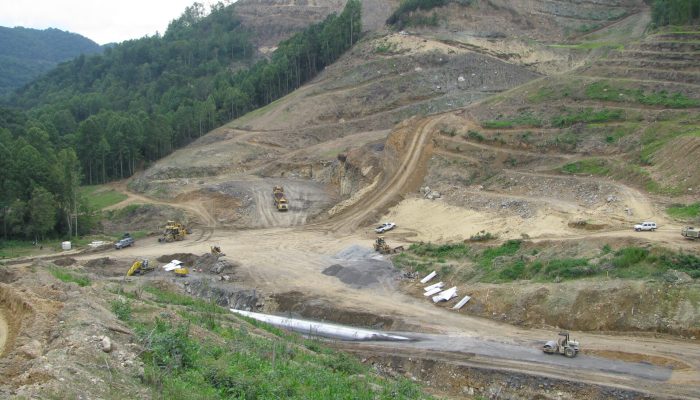
Coalfields Expressway – US121 West Helen thru Allen Creek, WV
Another phase of the famed Coalfields Expressway started in April 2010, continuing its southwesterly wind through the mountainous coal regions of southern West Virginia onward into southwestern Virginia. Grade and drainage construction by Bizzack on this $23.4M, 2.02 mile stretch through Raleigh County (West Helen through Allen Creek). A careful review of those numbers would lead even the most casual reader to ponder the difficulties that lay ahead the contractor for the next two years, and the answers are deep ~ 165’ deep.
Besides providing motorists with a four-lane partially controlled access highway, the corridor improvements will mitigate “No Passing” zones and areas of reduced speeds. However, the more painstaking measures will alleviate the steep grades that are the bane of the trucking industry, and this phase is no exception as the filling of a ravine became necessary to meet that objective.
As if the extraordinary amounts of fill weren’t enough, designers also needed to provide ample drainage along the bottom of that ravine which called for sizable pipe buried very deep, as much as 165’ deep. The solution was found in the strengths and sizes available with corrugated steel pipe (CSP), in this case, a specialized product called steel structural plate. Yet structural plate pipe was not just a solution but, under the circumstances, quickly became the only viable option, and was subsequently incorporated into the WVDOT project specifications.
Unlike corrugated steel pipe, corrugated steel structural plate is shipped to the site in curved plates and field assembled into its final shape by bolting. Structural plate is capable of being produced in heavier gages than those typically used for conventional CSP. Although CSP is inherently strong and can be used in deep burials without concern, the heights of cover attainable decreases as the diameter increases, and in this case the designers called for a 96” pipe to handle the expected drainage. At this size and depth the maximum plate thickness of 3/8” was specified by WVDOT.
Shipments from Lane Enterprises began in July 2010, with assembly slated to commence the week of July 19th. All in all, the 863’ alignment included 490 plates, altogether weighing over 250 tons. Without shipment limitations associated with large conventional pipe, combined with increased thicknesses and stiffer corrugations, SSP expands the number of useful applications and allows corrugated steel to be a viable alternative in the most demanding conditions.
Directional changes in the alignment were facilitated with structural plate elbows. The ability to incorporate elbows into the alignment eliminates the need for manholes, deep shafts or other costly alternatives, and at the same time provides structural continuity to the enclosure. The plate assembly crew kept pace through each alignment change with little to no difficulties.
The main feature of this particular structural plate job was the depth of bury, which was 165 feet at its deepest location. Project specifications required the plate manufacturer to corrugate, punch and curve 3/8” plate, the thickest plate material recognized in AASHTO material specifications. This thickness requires eight 7/8” bolts per foot (instead of the usual four 3/4” bolts) to provide the greater seam strength needed, resulting in a total of 46,400 bolts for the enclosure.
At 0.380” thick with a galvanized coating on each side, the 6” x 2” corrugated plate is still considered a flexible pipe material that derives its structural integrity from the soil-structure-interaction system developed with a structural backfill. In this case the project specifications called for select material commonly known as crusher run, a mixed grade of mostly small crushed stone in a matrix of crushed stone powder (i.e. a well-graded binder of fine material). This material provides maximum stability and pipe support for a given density due to the angular interlock of particles. Compacted in lifts equally on each side of the pipe to a height of two feet above the crown, the composite action mobilizes the full compressive strength of the corrugated steel plate.
Standard plate widths are designated by N, the number of 9.6” bolt spaces along the circumferential seam. To obtain the N value, the diameter is divided by three. With N determined, any combination of the five plate widths available (3N, 5N, 6N, 7N, 8N and 9N) can be used to form the pipe section. The ring of the 96” diameter pipe consisted of six plates, four 5N plates and two 6N plates. The 6N plates were placed at the invert and crown with the 5N plates in the remaining positions.
A total of 490 plates were needed for the 863’ alignment, with standard lengths of 10’ and 12’ to ensure the seams are appropriately staggered. On average the six-man assembly crew installed around 16 plates per day, longitudinally equating to 30’. The assembly began around July 19, 2010 and was substantially complete by the end of August, a good pace considering bolt quantities were doubled as noted above.
Aside from the three to five black bears a week, interspersed with a number of rattlesnakes and the occasional copperhead provided by the Wyco Hollow environs, the assembly of the structural plate pipe was a seamless operation from beginning to end, so to speak.
Related Posts
Bridge Maintenance Replacement ProgramBridge maintenance has redefined itself over the past decade as aging infrastructure…
Waterbury Branch Railroad Culvert ReliningRebuilding America’s infrastructure is the charge for today’s municipal stewards. The…