

Southeastern Pennsylvania Transportation Authority (SEPTA) Located in the Olney neighborhood of Philadelphia, the SEPTA R8…
Case Study: Eleventh Street Bridge at Macoby Creek
- atlas manager
- Buried Bridges, Case Studies, Design/Engineering Support, Steel Structural Plate Pipe Reline, Structural Plate
Pennsylvania Stone Arch Bridge Rehabilitation
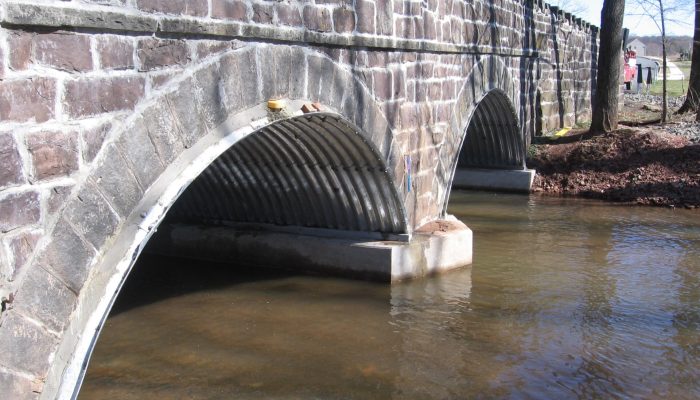
Anyone familiar with Pennsylvania’s landscape has grown quite fond of its quaint countryside and would place great value on preserving its charming appeal. Pennsylvania’s landmark bridges are the epitome of efforts to protect historic structures, attracting devotees from the private and public sectors alike. As the Nation’s leading host of authentic covered bridges, the Greater Philadelphia Region alone has North America’s largest population of stone-arch highway bridges. Pre-dating motorized vehicles, traffic, and the need to accommodate two-way travel, these single-lane icons are becoming increasingly difficult to protect, and any success in doing so is quickly touted as a victory. Rehabilitation of the double-barrel stone masonry arch crossing Macoby Creek along Eleventh Street in Upper Hanover Township, PA, undertaken by the Montgomery County Department of Roads and Bridges, presents such a victory.
Originally constructed in 1906, the aging bridge was in an ever-worsening condition, with deterioration of the concrete arch culverts and footers progressing in a downward spiral. Large cracks and spalling along the underside of each barrel were compounded by scoured footers and an eroded foundation. Already operating with a reduced load rating of ten tons the bridge was being slated for decommissioning until load capacity could be increased to current standards. The daunting question was whether to replace the structure, possibly upgrading it to AASHTO standards for a two-lane bridge, or rehabilitate the long-standing beauty.
The decision was made to preserve the structure to the extent possible by implementing a number of improvements to increase structural capacity and enhance right-of-way safety. The chief component needed to address structural deficiencies was corrugated steel structural plate, an engineering material long recognized as a standalone product but becoming used more and more as a relining material in rehabilitating aging infrastructure. To accommodate the relining the design engineer specified two 22’ long, 19’-0” x 5’-9½” structural plate arches.
As evidenced in the photo at right, increased deterioration of the concrete arch threatened the overall stability of the structure. An existing diagonal crack along the apex was noticeably widening with each successive inspection, and the footing was no longer providing scour protection.
Rehabilitation work started in October 2009. Due to an uncooperative winter, the project was not completed until May 2010. The first order of business involved the reconstruction of the arch footings, which had eroded over time and was progressively undermining foundation material.
Water being diverted from the work area allowed foundation rehabilitation to commence. Having sufficiently removed any loose material, workers began constructing the rebar cage around the main pier, followed by formwork and concrete pours. The procedure was followed in kind for the remaining piers.
The footings were constructed with an unbalanced channel cast into the top of the footer at the base of the arch. The unbalanced channel is a typical component for a plate arch, providing a groove for the plate edge to be positioned and ultimately fastened. With the footers completed, the plate reline operation was ready to begin. Structural plate is shipped to the site in curved plates and field assembled into its final shape by bolting.
Although plate assembly for reline jobs can take place within the structure itself, the project management team recognized the ease of first assembling the plate arch and then sliding the completed structure into position along the unbalanced channels. Some minor field modifications were made to the plate to accommodate a slight skew in one of the concrete arches, but overall the plate arch insertion went well.
The remaining task in the reline work consisted of constructing a bulkhead around the arch periphery so that the annular space between the plate and concrete could be pressure grouted. The structural plate included grout ports to facilitate the operation. Including grout ports at strategic locations around the arch periphery throughout its length ensures the grout to be evenly distributed throughout the annular space. Although structural plate is designed as a standalone product with appropriately compacted granular backfill, the composite interaction developed with the remaining portions of the concrete arch makes future capacity issues a moot point. To further solidify composite action with the entire structure, a reinforced concrete slab was constructed over the arches to better distribute vehicle loads and tie the fascia walls into the new deck.
The rehabilitation provided significant improvements to the surrounding community. The plate arch, foundations and concrete slab made the reduced load rating a thing of the past, allowing for emergency vehicles, school buses and other commercial traffic. Improved vertical alignment with upgraded signage substantially enhanced right-of-way safety. Now landscaped, the new Eleventh Street Bridge has truly found new life in the 21st Century … a historical restoration victory captured.
Related Posts
Bridge Maintenance Replacement ProgramBridge maintenance has redefined itself over the past decade as aging infrastructure…
Waterbury Branch Railroad Culvert ReliningRebuilding America’s infrastructure is the charge for today’s municipal stewards. The…