

Southeastern Pennsylvania Transportation Authority (SEPTA) Located in the Olney neighborhood of Philadelphia, the SEPTA R8…
Case Study: North Carolina DOT
Bridge Maintenance Replacement Program
Bridge maintenance has redefined itself over the past decade as aging infrastructure and ominous headlines serve as no small reminder of the importance of this most critical asset. Agencies across the country have kept pace, allocating funds and devoting resources towards the programs necessary to ensure these structures are appropriately maintained or replaced. With the thousands of small bridges that could be located within a single DOT maintenance district, coupled with today’s tough economic
times, this is no small task.
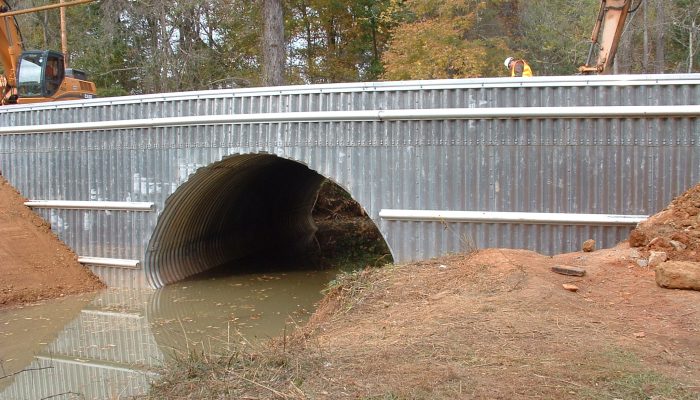
NCDOT has met the challenge with an innovative bridge maintenance replacement program that achieves the desired economy by minimizing design and construction costs and employing a specialty bridge material virtually unknown by many of today’s designers – Aluminum Structural Plate.
Categorically, small bridges include culverts of 54” diameter and larger. Integrating an aluminum structural plate headwall into the selected culvert size and shape creates an installation-friendly bridge replacement solution. With no rebar schedules, mix specifications, pours, frequent testing, cure times, et al., aluminum structural plate headwalls are an excellent alternative to concrete. Engineering costs are streamlined by incorporating design and resident engineering services into the material bid specification. In short, the manufacturer is responsible for engineering design, drawings and construction supervision. The headwalls are structurally engineered as a cantilevered retaining wall, with the forthcoming calculations and dimensions incorporated into a submittal subject to NCDOT approval.
Construction costs are mitigated by managing the bridge replacements as maintenance projects using NCDOT equipment and workers. The aluminum structures are easily managed, requiring no rental equipment or specially trained operators. A typical installation is effected with little more than an excavator and loader.
NCDOT maintenance workers assemble the structures on-site under manufacturer supervision. Assembly is usually completed on the same day. Ideally, the structure is completely assembled to form a one-piece, drop-in solution.
In most cases, the road remains open during assembly. At times, one lane may be needed, requiring some minor traffic coordination. To expedite project completion, the excavation may be concurrent with assembly. Two-barreled structures can still be assembled and mobilized as an integrated unit. However, experience with headwalls several hundred feet long shows that segmented construction is to be expected, albeit minimized to the extent possible.
Once the bridge or segment is assembled, the unit can be hoisted and placed in the excavation. When the structure is properly set, the excavation can be backfilled and prepared for road restoration.
Depending on the design, there may be some finishing touches before placement of the road subgrade. Deadmen anchors are tied back from each headwall and/or the headwalls are directly connected via threaded rods and turnbuckles to further stiffen the headwall culvert-backfill interaction system.
Once restoration is complete, the roadway may be immediately opened. Typical road closures between one and four days can be expected, making this the most desirable feature with the end user.
Headwalls are fabricated at Lane’s Statesville, NC, facility and shipped with the culvert stub completely welded to the periphery, and many are skewed to match the in situ road crossing. The barrel may be aluminum, aluminized steel, or, in some instances, aluminum structural plate to accommodate the larger spans. In any event, an aluminum structural plate headwall-culvert system is the option not to be overlooked when budgeting bridge replacement projects.
Related Posts
Waterbury Branch Railroad Culvert ReliningRebuilding America’s infrastructure is the charge for today’s municipal stewards. The…
First & Main Storm Water Management System OptimizationWith the onslaught of new water quality devices,…