

Southeastern Pennsylvania Transportation Authority (SEPTA) Located in the Olney neighborhood of Philadelphia, the SEPTA R8…
Case Study: Virginia Tech, Blacksburg, VA
- atlas manager
- Case Studies, HDPE Accessories, HDPE Water Quality Units, Storm Water Management, Underground Storage, Retention Systems, and Chambers
Lane Stadium Lot Fitted with Lane Drainage Products
Hokie football fans find improvements to the Lower Chicken Hill lot that accommodate their second-favorite pastime: Hokie tailgating. What was once simply gravel, grass, and dirt has been replaced with a state-of-the-art, engineered lot complete with curb, gutter, landscaping, and most notably, drainage. Tailgating has quickly become an American hallmark event worthy of organized support and promotion, and this project and related efforts show the value the game has for its fans.
As today’s civil and site engineers will testify, simple developments of this nature are far from being simply accomplished, and this case was no exception. Pinpointing water quality targets and requirements is further complicated by the site serving as a drainage junction for nearly 20 acres from several directions. In such a case, pavement and landscaping become trivial in the grand scheme of things and only serve to ice the cake.
As in many instances, the historical outlet for the site had become overtaxed as upstream acreage tends to increase imperviousness over time. The improvements slated for the parking area quickly became an opportunity to address water quality and quantity concerns, and the Virginia Department of Conservation and Recreation (DCR) decided to directly manage related measures.
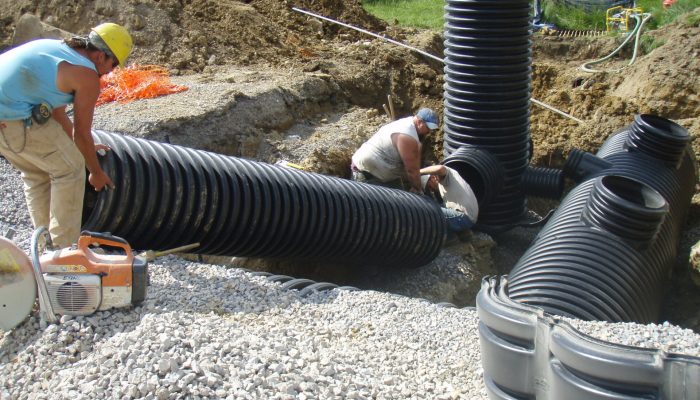
The preferred solution was to use a 20’ long, 48” HDPE water quality unit in tandem with a 48” HDPE storm water detention system, both of which were manufactured by Lane Enterprises, LLC. The volume of storage provided in the detention system was nearly 20,000 cubic feet, and used in conjunction with Lane’s CFT (Counter Flow Technology) water quality unit, was transformed into a sustainable pollutant-removing arrangement that addressed both of the quantity and quality issues at hand.
Lane’s CFT water quality unit is typically used as a stand-alone device, normally installed alongside storm sewer runs in an apparent dichotomy with respect to the storm water management system (SWMS). But the combination is beginning to show signs of a winning formula with many agencies, thanks to the sustainable feature it provides for SWMS.
Counter Flow Technology is introduced as the flow diverted into the water quality unit is redirected in a course opposite to the primary flow path. The reverse flow path is obtained using a vertical partition that longitudinally bisects the sediment chamber to create an extended travel path and isolates stored sediment from any adverse turbulent affects. In this case a 6” orifice outlet throttles the CFT to treat roughly 1.25 cfs before the unit is bypassed by toppling the diversion plate in the flow control riser.
The CFT is easily installed with minimal labor and equipment alongside the bypass line. The HDPE flow control riser is just as easily mobilized and presents quite the contrast with comparable concrete structures. The ability to fabricate custom fittings, orifice plates, weirs, et al., with handheld extrusion welders creates a substantial cost advantage over other engineering materials, especially at the construction stage.
In lieu of a drop manhole a diversion plate was used in the flow control riser to produce the driving head necessary for the water quality unit to function. In such a case the CFT is positioned in elevation by matching the crown of the inlet stub to the top of the diversion plate. The water quality unit is then laid level to create a sump condition that captures sediment in the first chamber, while an inverted weir (i.e., oil baffle) traps floatables in the second chamber.
When it’s all said and done, the manhole covers are the only evidence of the underlying work, and for illustration purposes serve to highlight the sustainable feature the CFT affords the detention system. With the ability to capture oil, debris, and over 80% TSS (and by particle absorption up to 15% phosphorous), the CFT provides an easily accessible focal point for clean-out operations, which could be accomplished in minutes, sustaining the detention system virtually maintenance-free for years to come.
Related Posts
Bridge Maintenance Replacement ProgramBridge maintenance has redefined itself over the past decade as aging infrastructure…
Waterbury Branch Railroad Culvert ReliningRebuilding America’s infrastructure is the charge for today’s municipal stewards. The…